 Breaking News & Live Updates
- Breaking News & Live Updates
- Breaking News & Live Updates
- Breaking News & Live Updates
- Breaking News & Live Updates
- Breaking News & Live Updates
- Breaking News & Live Updates
- Breaking News & Live Updates
- Breaking News & Live Updates
- Breaking News & Live Updates
Cultivating Connection: Practical Approaches to Enhance Empathy in Relationships
Empathy, the profound ability to understand and share the feelings of others, serves as an indispensable element in cultivating robust and fulfilling relationships. It acts as a bridge, fostering deeper intimacy and strengthening bonds, ultimately leading to greater satisfaction and a sense of being cherished within connections. While some individuals may exhibit a natural inclination towards empathy, the reassuring truth is that this vital relational skill can be consciously developed and honed by anyone, through consistent effort and practice.
Empathy is a multifaceted process that involves both the cognitive understanding of another's thoughts, feelings, and perspective (cognitive empathy), and the emotional resonance with their experience (affective empathy). In the context of relationships, this translates into concrete actions: observing a friend's quiet demeanor and inquiring about their well-being; attentively listening to a partner's frustrations without immediate defensiveness; or striving to comprehend why a family member holds a different viewpoint on a particular issue. However, genuine empathy transcends mere mind-reading. While accurately inferring another's internal state is valuable, it is crucial to remember that even those with profound connections can misinterpret. Therefore, direct inquiry, rather than assumption, is paramount to truly grasping another's feelings. It’s about engaging with their inner world, responding with genuine care, and remaining receptive to their unique lived experience.
The cultivation of empathy holds immense importance for several reasons. Primarily, the fundamental human need to feel understood is central to all healthy, close relationships. When individuals feel heard, validated, and genuinely cared for, it significantly enhances intimacy and overall relationship well-being. This principle applies not only to everyday interactions, such as joint decision-making or mutual support in daily tasks, but becomes particularly crucial during periods of disagreement or conflict. Empathy transforms the dynamic from a contest of 'who is right' to an exploration of 'what is happening here,' allowing both parties to acknowledge differing experiences of the same situation while striving to understand each other's perspectives. This shift enables individuals in close relationships to deepen their knowledge of one another, strengthen their emotional connection, and navigate conflicts with greater ease and constructiveness.
Building empathy can be particularly challenging when one feels criticized, disagrees with another's stance, or believes they already grasp the other's motivations. Yet, adopting specific habits can significantly aid in this process by signaling a genuine interest in understanding the other's viewpoint. These practices include: actively listening to truly understand, rather than merely waiting for a turn to speak; posing questions instead of making assumptions about their feelings or intentions; reflecting back what you've heard to confirm accurate comprehension; validating their emotions, which means acknowledging their feelings without necessarily agreeing with their perspective; and cultivating a continuous sense of curiosity, asking oneself, “What might their experience be?” or “What aspects of their perspective might I be overlooking?”
Navigating moments of difficulty and disagreement often presents the greatest challenge to empathetic engagement, as our own perspectives and self-preservation instincts can overshadow our ability to connect. Nevertheless, even minor adjustments in communication can yield substantial improvements. Consider scenarios such as a partner feeling neglected, a sibling making a questionable life choice, a friend repeatedly discussing the same issue, or a loved one reacting intensely to what seems like a minor event. Instead of defensive or dismissive responses, an empathetic approach involves acknowledging their feelings, seeking to understand their reasoning, and offering support tailored to their actual needs, whether it's simply a listening ear or a willingness to discuss options. Furthermore, when personal defensiveness arises, empathy encourages acknowledging the other's feelings while also articulating one's own experience, fostering a balanced dialogue. Even when faced with problems beyond our control or when needing to establish boundaries, empathetic communication allows for respect of the other's experience while honoring personal needs, demonstrating that understanding does not always equate to capability or obligation to intervene.
To foster empathy in relationships, it is not essential to possess perfect understanding or articulate flawless responses. The core lies in a genuine commitment to active listening, maintaining curiosity about another's world, verifying your comprehension, and responding with sincere care. In moments of uncertainty, a simple yet powerful phrase like, “Please help me understand what this feels like for you,” can open doors to profound connection and mutual understanding. This continuous journey of empathetic engagement strengthens the fabric of our relationships, making them more resilient, supportive, and ultimately, more rewarding.
Other Articles

Empowering Autistic Students: A Guide for Inclusive Classrooms
This article explores effective strategies for fostering an inclusive and supportive learning environment for autistic students. It emphasizes recognizing and leveraging their unique strengths, such as intense focus and pattern recognition, while adapting cognitive activities to suit their learning styles. The text also provides guidance on understanding and responding to meltdowns and stimming, creating sensory-friendly classrooms, and the critical role of collaboration with families and specialists. The overarching message is to embrace neurodiversity and move beyond a deficit-based approach to education.

Exploring the Essence of Meditation: From Ancient Roots to Modern-Day Benefits and Practical Implementation
This article delves into the practice of meditation, examining its historical origins, diverse benefits for psychological, cognitive, physiological, behavioral, and interpersonal well-being, and offering practical advice on establishing and maintaining a meditation routine. It addresses common challenges faced by new practitioners and emphasizes that meditation is a journey of self-discovery rather than a rigid discipline, highlighting its accessibility and scientifically backed positive impacts on daily life.

Four Transformative Advantages of Self-Kindness
Self-compassion, a cultivated ability, significantly enhances well-being. Research indicates its profound influence on mental health, reducing anxiety, depression, and stress. It fosters resilience under pressure, enabling quicker recovery from adversity, and promotes intrinsic motivation over self-criticism. Furthermore, self-compassion strengthens interpersonal bonds by encouraging empathy and constructive conflict resolution. Embracing this practice leads to a more fulfilling and connected existence.

A Comprehensive Guide to Cultivating Self-Compassion
This article explores the concept of self-compassion, defining it through its three core components: self-kindness, common humanity, and mindfulness. It differentiates self-compassion from self-esteem and self-love, highlighting its unconditional nature and resilience against external outcomes. The piece also offers practical advice on developing self-compassion as a skill, emphasizing its benefits for mental well-being.

Enhancing Remote Team Connection Through Virtual Communication Activities
This article explores the growing necessity of virtual communication games for fostering stronger bonds and more effective collaboration within remote and hybrid teams. It delves into the benefits of robust team communication, common challenges faced by virtual teams, and provides a structured approach to selecting, implementing, and debriefing various types of virtual games. The piece emphasizes the importance of intentional design, clear instructions, and post-activity reflection to maximize learning and connection among team members.
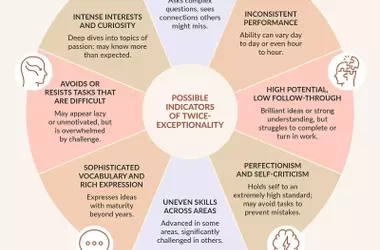
Supporting Twice-Exceptional Students: Strategies for 2e Learners
This article explores the complexities of twice-exceptional (2e) students, who possess both exceptional talents and learning challenges. These dualities often lead to their true potential being overlooked or misunderstood. We delve into identifying the unique characteristics of 2e learners, understanding their asynchronous development, and addressing the emotional impact of their experiences. Furthermore, we outline practical strategies for educators and families to foster an environment where 2e students can thrive by recognizing their strengths and providing tailored support without compromising expectations.