 Breaking News & Live Updates
- Breaking News & Live Updates
- Breaking News & Live Updates
- Breaking News & Live Updates
- Breaking News & Live Updates
- Breaking News & Live Updates
- Breaking News & Live Updates
- Breaking News & Live Updates
- Breaking News & Live Updates
- Breaking News & Live Updates
Open Dialogue Approach Reduces Psychiatric Hospital Use
A New Horizon in Mental Wellness: Beyond Conventional Psychiatric Care
Understanding the Open Dialogue Model: A Collaborative Path to Mental Wellness
The Open Dialogue model, a distinctive non-medical approach to mental health, has demonstrated a significant capability to decrease the necessity for hospitalizations in psychiatric crises while simultaneously elevating patient contentment with their care. This method, originating from Finland, places profound importance on strengthening relationships, ensuring continuity of care, and fostering collaborative decision-making processes.
The ODDESSI Trial: Unveiling Promising Outcomes for Mental Health Treatment
A landmark trial, known as ODDESSI, published in The Lancet Psychiatry, examined the efficacy of Open Dialogue against conventional treatment methods. The study encompassed 494 individuals in England experiencing mental health crises. Participants receiving Open Dialogue exhibited markedly improved rates of recovery, an enhanced quality of life related to health, and higher satisfaction with the services provided, compared to those undergoing standard treatment.
Minimizing Hospitalization Risks: A Key Achievement of Open Dialogue
A particularly compelling finding from the ODDESSI trial was that individuals engaged in Open Dialogue were over three times more likely to circumvent psychiatric inpatient admissions entirely over a two-year observation period. Furthermore, they experienced a reduced likelihood of being referred back to crisis intervention or specialized mental health services, underscoring the approach's preventative power.

Beyond Traditional Treatment: The Core Principles of Open Dialogue
Open Dialogue fundamentally diverges from conventional mental health provision by embracing a holistic and inclusive approach. It involves the individual, their familial and social networks, and dedicated OD practitioners who maintain consistent engagement throughout the care journey. Meetings are structured to cultivate a shared understanding of the individual's experiences, thereby empowering personal agency and nurturing crucial relationships.
Expert Endorsements and Insights: Validating a Relationship-Centered Approach
Professor Russell Razzaque, a consultant psychiatrist and co-author of the study, emphasized the significance of these findings, noting that current mental health services often result in a cycle of crises and readmissions. He stated that a care model built on robust relationships and mutual decision-making leads to improved recovery, better quality of life, and a diminished reliance on inpatient facilities.
Acknowledging Nuances: Relapse Rates and Methodological Considerations
Despite its successes, the study included certain qualifications. Open Dialogue did not outperform standard treatment in delaying relapse following initial recovery, which was defined by the recurrence of significant symptoms and a decline in social functioning. Dr. Tomi Bergström, a leading expert on Open Dialogue, commented in an invited piece for The Lancet Psychiatry that while relapse time is a common metric in psychiatric research, its relevance as the primary endpoint for evaluating Open Dialogue merits further discussion.
Adapting the Model: Variations in Open Dialogue Implementation
It is important to note that the version of Open Dialogue implemented in the UK trial varied from its Finnish origins. For instance, it did not fully incorporate certain family and psychological interventions typical of Open Dialogue practice elsewhere. The involvement of family and friends in network meetings also occurred less frequently than initially envisioned by the researchers.
Personal Narratives: The Transformative Impact of Inclusive Care
Rachel Banister, who sought Open Dialogue support for her daughters, shared her family's positive experience. She recounted how conventional services often excluded her family from decision-making, forcing her daughter to repeatedly recount her experiences. Open Dialogue, in contrast, fostered an environment where all family members felt heard and understood, leading to a profound shift in their interactions and understanding.
Looking Ahead: Expanding Access and Further Research
Researchers are actively working to broaden the accessibility of Open Dialogue across the UK and to continue investigating its efficacy, particularly its potential to reduce the demand for psychiatric inpatient beds. This ongoing effort aims to solidify the role of Open Dialogue as a vital component of contemporary mental health car
Other Articles

The Perils of Psychiatric Labels: Misdiagnosis, 'Sticky' Diagnoses, and Overlooking Physical Illness
New research highlights significant concerns within psychiatric diagnosis, exploring how childhood autism and ADHD labels can persist into adulthood even when criteria are no longer met. The validity of current ADHD diagnostic criteria is questioned due to vagueness and arbitrary thresholds. Furthermore, two case studies illustrate the danger of diagnostic overshadowing, where psychiatric diagnoses can lead to physical symptoms being misinterpreted and underlying medical conditions being left untreated, emphasizing the need for comprehensive evaluation.

Scrutiny Over New PTSD Device Authorization and Public Information Access
The FDA has granted marketing authorization for Modius Spero, a new neuromodulation device for PTSD, despite the absence of public data from its clinical trials. Media outlets have largely echoed the company's press release without critical examination of efficacy or potential side effects, raising concerns about informed decision-making for both medical professionals and patients.

Beyond the Clinic: The Transformative Power of Peer-Led Recovery in Addiction
This article explores the limitations of traditional addiction treatment models, which often measure success by program completion rather than long-term sobriety. Drawing on personal experience, the author advocates for peer-led recovery housing as a more effective approach. These environments foster real-world accountability and provide practical tools for navigating everyday life challenges, offering a sustainable path to recovery that clinical settings often miss.

The Perils of Pathologizing Emotions in Modern Medicine
This article delves into the critical issue of how the medical profession often misinterprets and pathologizes common human emotions, particularly anxiety, leading to a mechanistic 'diagnose and prescribe' approach. It advocates for a more humanistic and holistic understanding of patients' experiences, emphasizing the intricate connection between emotional well-being and physical symptoms, and calls for a paradigm shift to integrate clinical understanding with individual life contexts for more compassionate and effective care.

Challenging the Scientific Consensus on ADHD: A Critical Examination of Diagnosis and Treatment
This article critically examines the prevailing scientific consensus surrounding ADHD, particularly in response to a Channel 4 documentary that questioned its nature. It delves into the ongoing debate regarding ADHD as a neurodevelopmental disorder versus a social construct, scrutinizes the validity of diagnostic practices, and investigates the efficacy and safety concerns associated with stimulant medications. The piece highlights the long-standing scientific controversies, the potential for premature mortality linked to diagnoses and treatments, and the implications of rising diagnosis rates on the understanding of human behavior.
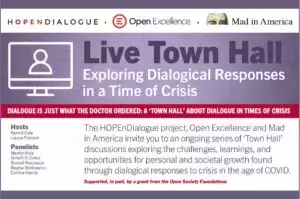
The Power of Dialogue: Fostering Safe Spaces for Mental Health Crisis Response
This article highlights Mad in America's commitment to creating safe spaces for dialogue concerning mental distress and its treatment. Drawing parallels with the 'Open Dialogue' approach, it emphasizes how open communication, especially from those with lived experiences, can lead to more effective and humane responses to mental health crises, moving beyond conventional medical interventions. The piece also previews upcoming events aimed at deepening this crucial conversation.