 Breaking News & Live Updates
- Breaking News & Live Updates
- Breaking News & Live Updates
- Breaking News & Live Updates
- Breaking News & Live Updates
- Breaking News & Live Updates
- Breaking News & Live Updates
- Breaking News & Live Updates
- Breaking News & Live Updates
- Breaking News & Live Updates
Mastering Emotional Intelligence: The Power of Emotional Literacy
Emotional intelligence, frequently considered an intrinsic characteristic, is, contrary to popular belief, a learned proficiency. The cornerstone of its development resides in nurturing 'emotional literacy'—the capacity to precisely discern, verbalize, and communicate one's inner states. This fundamental competence empowers individuals to gain a deeper understanding of their own emotional world and the sentiments of those around them, thereby fostering more robust and profound connections. Building this essential skill lays the groundwork for all other aspects of emotional intelligence to flourish.
The Core of Emotional Intelligence: Unveiling Emotional Literacy
The journey to heightened emotional intelligence begins not with abstract concepts like empathy or self-regulation, but with the tangible skill of emotional literacy. This involves developing a rich vocabulary for feelings, moving beyond simplistic labels to pinpoint the exact emotions experienced. By consciously practicing the identification and articulation of these nuanced inner states, individuals create a solid foundation upon which more complex emotional competencies can be built. This foundational practice is crucial for anyone seeking to improve their emotional responsiveness and connection with others.
Emotional intelligence, as defined by pioneering psychologists, involves the acute perception of one's own emotions and those of others, the interpretation of these emotional cues within relationships, and the effective management of feelings both internally and in interactions. Rather than a fixed personality trait, it is a dynamic skill, much like a language that can be learned and expanded. The absence of emotional literacy can manifest as difficulty in naming emotions, dismissing a partner's feelings, or withdrawing during challenging conversations. Conversely, a high degree of emotional intelligence fosters an environment of emotional security, where individuals feel safe to express their true selves. This involves actively engaging with a partner's emotional bids, allowing oneself to be influenced, and proactively repairing breaches in connection, signaling a profound understanding and acceptance of emotional realities.
Cultivating Emotional Understanding: From Words to Connection
The practical pathway to augmenting emotional intelligence is rooted in expanding one's emotional lexicon. Many individuals tend to rely on a limited range of terms like 'fine,' 'stressed,' or 'annoyed,' which fail to capture the full spectrum of their internal experiences. By deliberately broadening this feeling-vocabulary and habitually articulating these precise emotions, individuals gain greater clarity and precision in their emotional expression. This initial step of literacy is vital, as one cannot effectively manage an emotion that remains unnamed or poorly understood. It is through this clear articulation that emotions can be effectively shared and responded to with greater accuracy in relationships.
Once emotional literacy is established, two complementary skills further enhance emotional intelligence: attunement and structured practice. Attunement involves actively engaging with a partner's emotional state, staying present and responsive to their feelings—a skill that is acquired through consistent effort, rather than being innate. Structured practice, facilitated by tailored programs and tools, helps embed the habit of translating feelings into communicable expressions that a partner can understand and accept. These incremental, repetitive efforts, though seemingly minor, are profoundly transformative for relationships over time. Emotional intelligence is not an inherent talent but a developmental process, achievable at any age through sustained practice and a willingness to learn and adapt, akin to expanding one's linguistic abilities.
Other Articles

Unpacking Permissive Parenting: Identifying and Shifting Towards a Balanced Approach
This article explores the nuances of permissive parenting, often stemming from a desire to foster happiness but potentially hindering a child's development. It outlines five key indicators of an overly lenient approach and offers actionable strategies for parents to integrate structure and consistency with existing warmth, promoting self-regulation and positive outcomes for children. Backed by research, the piece encourages a balanced parenting style without judgment, emphasizing the importance of both love and clear boundaries for a child's thriving.

Cultivating Inner Peace Amidst Physical Discomfort: A Guided Meditation Journey
This guided meditation, led by Juliana Sloane, offers a unique approach to managing chronic pain and illness. It encourages individuals to develop self-compassion and find comfort by using imaginative and mindfulness-based techniques. The practice focuses on gently bringing awareness to various body parts, inviting relaxation, and then using visualization to transform sensations of discomfort into feelings of kindness and support, ultimately promoting a sense of inner peace and well-being.
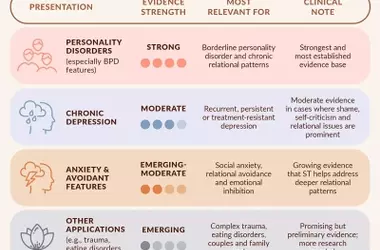
Schema Therapy's Effectiveness: Evidence and Progress in Mental Health Treatment
Schema therapy offers a unique approach to deeply ingrained emotional difficulties by integrating cognitive, experiential, behavioral, and relational techniques. This article delves into the current evidence supporting its efficacy, particularly for complex conditions like personality disorders. It also explores how progress is measured, practical monitoring schedules, and strategies for overcoming treatment plateaus. Furthermore, the importance of therapist training and supervision in achieving successful outcomes is highlighted, providing a comprehensive guide for practitioners considering or utilizing schema therapy.

The Power of Emotional Refuge in Relationships
This article explores the crucial role of emotional refuge within romantic relationships, especially for individuals who have experienced external judgment and rejection. It highlights how a supportive partnership can counteract negative societal messages, fostering self-acceptance and healing. The piece emphasizes that true love creates a sanctuary where individuals can be their authentic selves, free from contempt, and grow together in mutual respect and humility.

Bridging Meditation and Daily Decisions: The Power of Micro-Practices
This article explores how integrating 'micro-practices'—brief, intentional pauses—into daily life can transform choices beyond traditional meditation. It highlights the author's personal journey of questioning consumer habits and introduces an 'Eight Skills' framework, emphasizing that while longer meditation builds capacity, micro-practices are crucial for applying mindfulness in real-time, enabling alignment between values and actions in everyday moments.